
Podcast: Maximizing Disability Coverage for New Attending Physicians

In this episode of the Cover Your Assets podcast, host Billy Gwaltney discusses the intricacies of private specialty disability coverage for physicians, particularly focusing on how and when they can increase their coverage after graduation. The conversation highlights the importance of understanding insurance guidelines, the relationship between attending salary and coverage amounts, and the necessity of timely adjustments to ensure adequate protection against potential disabilities.

Takeaways:

  • Physicians often start with lower coverage amounts during training, but it’s important insurance carriers calculate coverage based on attending salary.
  • Proactive adjustments to coverage are necessary to ensure adequate protection. We recommend increasing coverage within 90 to 180 days of starting a new job.
  • The cost of coverage increases proportionally with the benefit amount.
  • Claims are based on the coverage amount at the time of the claim.
  • Graduates can start at the attending benefit level if eligible.
  • Different riders have different guidelines for increasing coverage.

For more tips and advice, connect with the CYA Podcast on YouTube and visit the Professional Planning Group online. Stay up to date with Billy on Facebook and LinkedIn.

If you have questions, feedback, or just want to connect, email Billy at billy@ownoccdisability.com.

Podcast: Group Disability Policies Vs. Private Specialty Coverage

In this episode of the Cover Your Assets podcast, host Billy Gwaltney discusses the critical differences between group disability policies offered through associations and private specialty coverage. He emphasizes the importance of understanding the gaps in association policies, including definitions of disability, control over the policy, and the significance of individual coverage. The conversation highlights the potential pitfalls of relying on association policies and the benefits of securing a private policy for long-term financial security. As a cautionary tale, here is a first-hand account from a clinical anesthesiology who was forced to retire by a disability and found out the hard way the limits many of these group policies can have for medical professionals.  

Takeaways:

  • Group disability policies often have significant gaps.
  • Private specialty coverage offers a true specialty definition.
  • Association policies may not pay if you earn income elsewhere.
  • Private policies provide fixed rates that never increase.
  • Association policies can change terms and rates at any time.
  • Individual policies give you control over your coverage.
  • Partial benefits can be crucial for those not totally disabled.
  • Long-term recovery benefits are rarely found in association policies.
  • It’s essential to read the fine print of any policy.
  • Understanding your coverage is vital for financial security.

For more tips and advice, connect with the CYA Podcast on YouTube and visit the Professional Planning Group online. Stay up to date with Billy on Facebook and LinkedIn.

If you have questions, feedback, or just want to connect, email Billy at billy@ownoccdisability.com.

Navigating Disability Insurance: Graded vs. Level Premiums

Summary:

In this episode of the Cover Your Assets podcast, host Billy Gwaltney discusses the intricacies of selecting a graded premium policy for private specialty disability coverage. He explains the differences between graded and level premiums, emphasizing the long-term financial implications of each choice. The conversation highlights the importance of understanding the terms of disability insurance policies, especially for physicians, and provides insights into when a graded premium might be a viable option. Billy also addresses the common misconception that lower initial premiums equate to better deals, urging listeners to consider the long-term costs associated with graded premiums.

Takeaways:

  • Graded premiums start lower but increase over time.
  • Level premiums provide stability in long-term costs.
  • Understanding the terms of your policy is crucial.
  • There is no free lunch in the insurance world.
  • Most clients end up keeping their insurance despite financial independence.
  • Graded premiums can be beneficial for guaranteed issue policies.
  • It’s essential to confirm the type of premium you’re getting.
  • Wealthy individuals often still opt for insurance coverage.
  • Long-term planning is key when selecting a premium type.
  • Consulting with an expert can clarify your options.

(00:20) Welcome

(00:46) Understanding Graded vs. Level Premiums

(04:15) Long-Term Financial Planning with Premiums

(06:37) When Graded Premiums Make Sense

(08:29) The Importance of Disability Insurance for Wealthy Individuals

The Cover Your Assets Podcast is on a mission to help physicians like you get their disability insurance right. You’ve spent years of your life and hundreds of thousands of dollars to become a physician — this is the career that will give you and your family everything you’ve dreamed of! Don’t let accidents, illness, or injury destroy your hard work and the life you deserve. You know you need to be insured, but how do you sort through the mountains of information when you barely have enough time to eat? On the Cover Your Assets Podcast, host Billy Gwaltney, head of Professional Planning Group, Inc., shows you exactly what you need to do to protect your income and way of life.

For more tips and advice, connect with the CYA Podcast on YouTube and visit the Professional Planning Group online. Stay up to date with Billy on Facebook and LinkedIn.

If you have questions, feedback, or just want to connect, email Billy at billy@ownoccdisability.com.
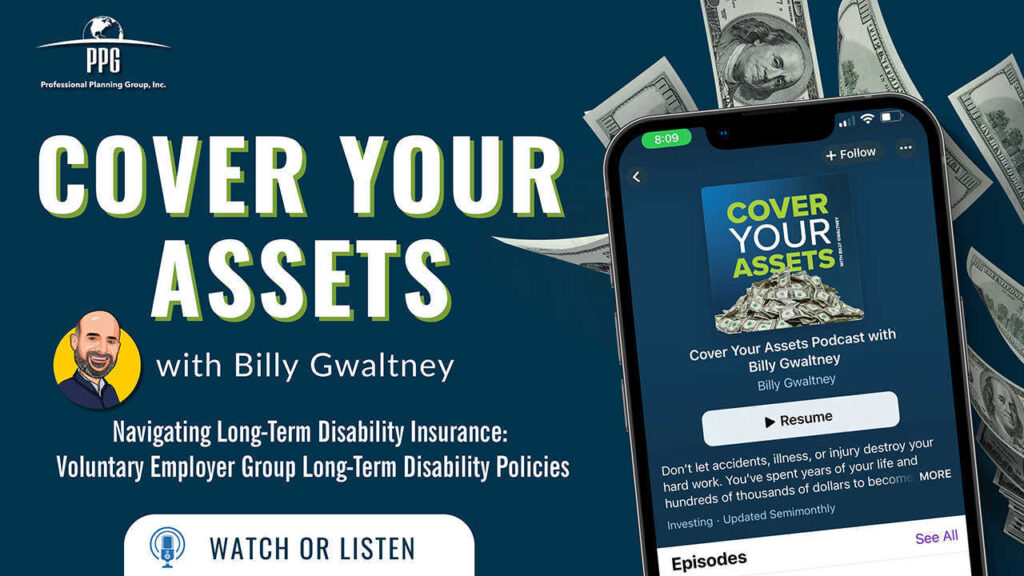
Should I opt out of my voluntary employer group long-term disability policy?

In this episode, Billy Gwaltney discusses the complexities of long-term disability (LTD) policies, particularly focusing on the differences between employer group policies and private specialty coverage. He emphasizes the importance of understanding the definitions of disability and the potential gaps in employer policies, advocating for physicians to consider opting out of voluntary group LTD if they have a properly designed private policy.

Takeaways:

  • Should I opt out of my voluntary employer group policy?
  • There is a big difference between how different policies define being disabled.
  • The key for doctors is specialty specific language and ensuring you get the best definition.
  • If you get the right definition, you can collect your policy benefit while still earning income.
  • The best step to ensure your coverage is to speak with a broker who specializes in occupational disability for physicians.

I would be happy to answer any questions.

Listen to the episode wherever you get your podcasts or watch the full video below.

Do I Pay an Extra Fee to Work With You?

Do you have to pay an extra fee to work with a broker? Spoiler alert: The answer might surprise you. In this episode of Cover Your Assets, host Billy Gwaltney breaks down how broker commissions are structured within insurance premiums and the value that a dedicated broker can bring to the table. Whether you’re in the early stages of your career or an established professional, understanding this aspect of your coverage can provide peace of mind and financial clarity.

Episode Highlights:

  • How broker commissions are structured. (01:14)
  • The role of a broker and the continuous, long-term support they provide. (02:39)
  • Advice for ensuring you’re working with a competent broker who earns their commission. (03:43)

The Cover Your Assets Podcast is on a mission to help physicians like you get their disability insurance right. You’ve spent years of your life and hundreds of thousands of dollars to become a physician – this is the career that will give you and your family everything you’ve dreamed of! Don’t let accidents, illness, or injury destroy your hard work and the life you deserve. You know you need to be insured, but how do you sort through the mountains of information when you barely have enough time to eat? On the Cover Your Assets Podcast, host Billy Gwaltney, head of Professional Planning Group, Inc., shows you exactly what you need to do to protect your income and way of life.

For more tips and advice, connect with the CYA Podcast on YouTube and visit the Professional Planning Group online. Stay up to date with Billy on ⁠Facebook⁠ and ⁠LinkedIn⁠. 

If you have questions, feedback, or just want to connect, email Billy at ⁠billy@ownoccdisability.com.⁠ 

If My Income Goes Up in the Future, What Happens to My Disability Policy?

Ever wondered what happens to your disability policy if your income increases in the future? In this episode of the Cover Your Assets Podcast, host Billy Gwaltney tackles this common question for physicians and other high-income professionals.

Through his expertise as an independent broker, Billy explores the intricacies of adjusting your private specialty occupation disability coverage as your salary grows. With insightful explanations and practical advice, you’ll understand how to keep your financial safety net robust as your career progresses.

Episode Highlights:

  • Explanation of future increase options and benefit increase riders. (02:06)
  • Insurance companies’ calculations for coverage amounts and potential caps. (03:39)
  • The critical need for proactively increasing your coverage; and what happens if you don’t. (05:38)

The Cover Your Assets Podcast is on a mission to help physicians like you get their disability insurance right. You’ve spent years of your life and hundreds of thousands of dollars to become a physician – this is the career that will give you and your family everything you’ve dreamed of! Don’t let accidents, illness, or injury destroy your hard work and the life you deserve. You know you need to be insured, but how do you sort through the mountains of information when you barely have enough time to eat? On the Cover Your Assets Podcast, host Billy Gwaltney, head of Professional Planning Group, Inc., shows you exactly what you need to do to protect your income and way of life.

For more tips and advice, connect with the CYA Podcast on YouTube and visit the Professional Planning Group online. Stay up to date with Billy on ⁠Facebook⁠ and ⁠LinkedIn⁠. 

If you have questions, feedback, or just want to connect, email Billy at ⁠billy@ownoccdisability.com.⁠ 

Cover Your Assets Newsletter – March Edition

Welcome to the Cover Your Assets (CYA) newsletter! My physician clients are always asking for additional expertise when it comes to financial planning and investments as they proceed in their careers. This monthly newsletter is meant to connect you with these additional resources as well as help build a community among physicians to share their experiences.In this edition, we look at the big issue of physician burnout and its causes, how to approach alt investments, and take a deep dive into what it’s like to file a specialty disability claim.

In the news

Only 32% of physicians under 45 own practices, down from 44% in 2012. This compares to 51% of physicians ages 45 to 55 who are owners. A growing number of physicians now work as employees at health systems and hospitals, rather than in private practice. If you’re an employee physician, check out my episode on why employer-provided long-term disability policies do not have the best interests of their employee physicians at heart

AI transcriptions for medical visits are already proliferating in hospitals despite serious risks of misdiagnoses stemming from their propensity to generate false quotes, including symptoms. The goal of these AI services is “to free up medical providers to spend less time on note-taking or report writing,” but until these hallucinations from generative AI are addressed, reliance on these systems could lead to serious patient harm.

The deep dive: What’s it actually like to file a disability claim against your occupational insurance?

No one expects to become disabled, especially if you’re a young doctor just starting your career. The irony is doctors see people every day who have experienced unexpected and catastrophic occurrences. In this case, you hope that your insurance premiums end up being wasted – that is, you avoid a serious accident or debilitating illness impacting your ability to practice your speciality such that you need your policy. 

But if you ever have to file a claim, what is the process? 

Fortunately, if you buy specialty occupation disability insurance from one of the four reputable insurers in this space, the process is relatively straightforward if you work with a specialist broker:

1. The disabled physician (let’s refer to him as the filer) fills out a claims form, either directly through your insurance company or else working through your broker if you sign an authorization for your broker to be involved (more on that later).

2. The insurer interviews the filer.

3. The insurer interviews the medical professional treating the filer to validate the medical condition.

4. The insurer interviews the filer’s employer to understand how the disability impacts the filer’s ability to practice their specialty.

5. The insurer validates the filers’ speciality based on the CPT codes they bill for.

6. Finally, the insurance company might conduct an in-person claims examiner, though this is not always required.

Once a claim has been validated, the insurance company starts sending payment for the lost income based on when the disability happened. What’s good for filers is there is typically no time limit from when an injury occurred to when the claim is filed. So let’s say a filer took a year from when the disability began preventing them from practicing their specialty to when they filed the claim, they didn’t miss some unknown filing window, and their first check will usually cover the full time from when their disability began.

Critically, if you buy the right specialty disability insurance, you will get payments for your lost occupation income even if you are able to work in a different specialty or field. The true specialty occupation definition of disability states that if you are unable to practice your specialty or subspecialty you can work in another job and still collect full policy benefits. So let’s say a surgeon injures her hands and can no longer conduct surgeries but she can still teach residents at the hospital, specialty disability insurance will still cover her lost income from being a surgeon even as she earns income in a different job.

This is the big difference versus the disability insurance offered through employers. If a surgeon can no longer be a surgeon but still do clinical hours, for example, most employer-provided disability plans will not go into effect.

So why involve me (or whomever your broker is)? 

First, as a broker with decades of experience and connections, I have a direct line of contact to the people reviewing these claims at the insurance companies. A normal filer usually has to go through general 800 numbers to get updates. And if a claim is rejected, it is very hard for them on their own to find out what happened.

For example, one of my clients had a stroke that left him partially blinded in one of his eyes. He initially filed his claim directly with the insurance company and was actually denied. In a last ditch effort, he reached out to me to ask if I could find out what happened. When I spoke directly with my contacts, they explained that my client’s physician had told them that my client said he was fine during a checkup.

In truth, like many doctors, my client had downplayed his own illness. Once his physician understood the true extent of his disability, the insurance company was able to go back and confirm that yes, my client was partially blind in one eye in a way that he could no longer perform his specialty as he had before the stroke.

Second, we know how to mediate the process whereas insurance carriers are not set up to do that. One of my clients had not received her disability payments for some time. We discovered she had missed a key form that had been sent in the mail months earlier, but which she didn’t know she was supposed to be on the lookout for.

As I tell my clients, my job doesn’t stop when you purchase a policy. Your circumstances will continue to change as you progress in your career and in life. My team and I are here to walk with you, providing ongoing guidance and support  so you can protect your most valuable financial asset – your ability to practice your field. 

Get $100 when you refer a friend

For each qualified lead you send my way to discuss disability insurance (details below), you get a $100 Amazon gift card, even if they don’t end up buying a policy through me.  

If you know any physicians in your network trying to figure out the right coverage for their situation, all you have to do is send an email introduction (or they can also say you referred them when we get on a call), and then I’ll notify you as soon as they qualify. Here’s a link to more information.

Is Working With a Disability Specialist Broker Better Than Working With a Financial Planner?

There IS a significant difference between working with a disability insurance specialist and a general financial planner when it comes to your financial security. As a seasoned specialist working with physicians across the country, Cover Your Assets host Billy Gwaltney provides valuable insights into why choosing a broker with in-depth expertise in disability coverage can make all the difference in your financial planning. Through relatable analogies and practical advice, Billy clarifies the distinctions between generalists and specialists in the insurance world. Learn why the devil is in the details when it comes to designing your disability insurance policy and how to safeguard your financial future with the right broker.

Episode Highlights:

  • The value of working with a specialist who has extensive experience in disability coverage. (02:13)
  • An explanation of rate increase scenarios and how they affect policyholders. (02:57)
  • Three crucial elements of an ideal disability insurance policy to ensure comprehensive coverage. (05:06)
  • Real stories where Billy has intervened to resolve claims issues and ensure clients received their rightful benefits. (09:21)

The Cover Your Assets Podcast is on a mission to help physicians like you get their disability insurance right. You’ve spent years of your life and hundreds of thousands of dollars to become a physician – this is the career that will give you and your family everything you’ve dreamed of! Don’t let accidents, illness, or injury destroy your hard work and the life you deserve. You know you need to be insured, but how do you sort through the mountains of information when you barely have enough time to eat? On the Cover Your Assets Podcast, host Billy Gwaltney, head of Professional Planning Group, Inc., shows you exactly what you need to do to protect your income and way of life.

For more tips and advice, connect with the CYA Podcast on YouTube and visit the Professional Planning Group online. Stay up to date with Billy on ⁠Facebook⁠ and ⁠LinkedIn⁠. 

If you have questions, feedback, or just want to connect, email Billy at ⁠billy@ownoccdisability.com.

What Is the Recovery Benefit and Do I Really Need It?

Take a deep dive with host Billy Gwaltney into the often-overlooked yet vital aspect of a robust specialty disability policy: the recovery benefit. Designed to continue providing support even after you medically recover, this benefit could mean the difference between financial stability and strain as you get back on your feet.

In this episode of Cover Your Assets, Billy outlines the key reasons why this benefit is indispensable, especially for physicians at their income peak, breaking down complex concepts into easily digestible insights. Tune in to learn why a well-crafted disability policy is like a three-legged stool and how missing out on the recovery benefit could leave you unbalanced.

Episode Highlights:

  • Three primary elements of a comprehensive disability policy. (01:25)
  • Real-life scenarios of how medical professionals, like pediatricians and surgeons, are impacted by the recovery benefit. (02:27)
  • Why group long-term disability and association policies fall short without a recovery benefit. (04:59)

The Cover Your Assets Podcast is on a mission to help physicians like you get their disability insurance right. You’ve spent years of your life and hundreds of thousands of dollars to become a physician – this is the career that will give you and your family everything you’ve dreamed of! Don’t let accidents, illness, or injury destroy your hard work and the life you deserve. You know you need to be insured, but how do you sort through the mountains of information when you barely have enough time to eat? On the Cover Your Assets Podcast, host Billy Gwaltney, head of Professional Planning Group, Inc., shows you exactly what you need to do to protect your income and way of life.

For more tips and advice, connect with the CYA Podcast on YouTube and visit the Professional Planning Group online. Stay up to date with Billy on ⁠Facebook⁠ and ⁠LinkedIn⁠. 

If you have questions, feedback, or just want to connect, email Billy at ⁠billy@ownoccdisability.com.⁠ 

What Is the Enhanced Residual Benefit and Is It Important for Me?

In this episode of Cover Your Assets, host Billy Gwaltney explains the crucial elements of a well-structured disability policy, focusing on the often-misunderstood Enhanced Residual Benefit. Billy explores why this benefit is a non-negotiable part of any physician’s robust disability insurance plan. Tune in to grasp the importance of this coverage and learn how it can protect you from financial instability if you can only work part-time due to illness or injury.

Episode Highlights:

  • Three non-negotiable elements of disability policies. (01:17)
  • Real-world cases illustrating the necessity of the benefit for part-time work scenarios. (04:32)
  • Common pitfalls to watch out for in association and group long-term disability policies. (05:43)

The Cover Your Assets Podcast is on a mission to help physicians like you get their disability insurance right. You’ve spent years of your life and hundreds of thousands of dollars to become a physician – this is the career that will give you and your family everything you’ve dreamed of! Don’t let accidents, illness, or injury destroy your hard work and the life you deserve. You know you need to be insured, but how do you sort through the mountains of information when you barely have enough time to eat? On the Cover Your Assets Podcast, host Billy Gwaltney, head of Professional Planning Group, Inc., shows you exactly what you need to do to protect your income and way of life.

For more tips and advice, connect with the CYA Podcast on YouTube and visit the Professional Planning Group online. Stay up to date with Billy on ⁠Facebook⁠ and ⁠LinkedIn⁠. 

If you have questions, feedback, or just want to connect, email Billy at ⁠billy@ownoccdisability.com.⁠